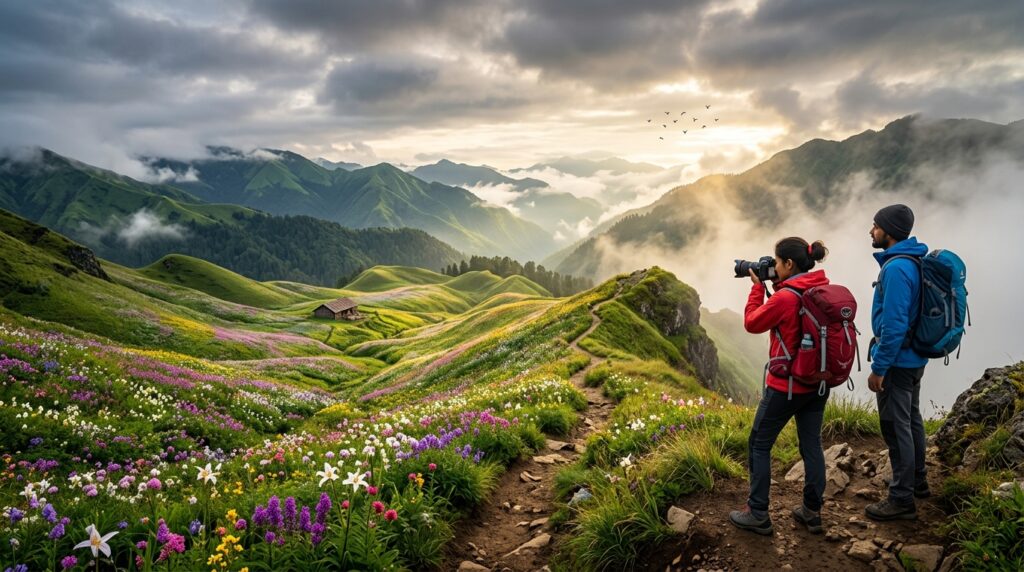
In July, the floor of Dzukou Valley turns purple and white. The Dzukou Lily a flower that grows nowhere else on earth blankets the entire high-altitude basin in a mass bloom that covers several square kilometres at 2,452 metres above sea level. Most people who trek Dzukou Valley have never heard of this. They go in December, see brown grassland, and come back thinking the valley is “nice.”
This guide is for the traveler who wants to understand what Dzukou Valley actually is before heading there the geography, the flora, the realistic trekking conditions, the seasonal differences, and the things that catch first-timers off guard. If you’re deciding whether to go, when to go, or how to prepare, this is the most practical guide you’ll find.
What Is Dzukou Valley and Why Is It Different from Other High-Altitude Treks in India
Dzukou Valley sits on the border of Nagaland and Manipur in Northeast India, at an altitude of approximately 2,452 metres. It is a large, treeless, bowl-shaped valley many geologists believe it sits in an ancient volcanic depression surrounded by ridges that rise another 300–400 metres above the valley floor.
What makes Dzukou genuinely unusual is the combination of three things you rarely find together: high altitude with no tree cover, an endemic flora found nowhere else in the world, and near-total absence of the commercial trekking infrastructure that has taken over popular routes in Himachal Pradesh and Uttarakhand.
There are no tea stalls along the trail. No fixed-rope sections. No crowds of trekkers moving in a line. The approach is a real mountain route through Nagaland’s forested hills, and the valley itself is quiet in a way that most Indian trekking destinations no longer are.
The closest comparison in spirit though not in landscape is the Valley of Flowers in Uttarakhand. But Dzukou is less visited, less regulated, and arguably more dramatic in peak bloom season.
The Star of the Valley: Dzukou Lily and the Endemic Flora
The Dzukou Lily (botanical name: Lilium mackliniae) was first documented by the British botanist Frank Kingdon-Ward in 1946. He named it after his wife Jean Macklin. The flower is pale purple-pink, nodding downward from a tall stem, and grows in dense colonies across the valley floor.
It blooms from late June through August, with peak flowering in July. During this window, the valley floor is so densely covered in lilies interspersed with other wildflowers that the effect looks more like a cultivated garden than a wild landscape. It doesn’t.
Outside this bloom window, the same plants are present but not flowering. In December, the valley looks entirely different a high grassland with winter-dried vegetation and occasional frost.
Beyond the Dzukou Lily, the valley hosts:
- Rhododendrons bloom in April and May on the surrounding ridges
- Orchids several species found in the forest sections of the trek
- Aconitum (monkshood) a tall purple flowering plant, mildly toxic, common in the valley in monsoon
- Strobilanthes known for mass flowering events that happen once every several years
The biodiversity here is the result of the valley’s unusual microclimate it traps moisture from the monsoon, receives heavy fog, and stays cooler than surrounding areas even in summer. The conditions suit endemic flora that couldn’t survive at lower altitudes or in drier terrain.
The Two Trekking Routes: Which One Should You Take
There are two established routes to Dzukou Valley, both starting from points accessible from Kohima.
Route 1 Viswema Village (Recommended for Most Trekkers)
- Starting point: Viswema village, approximately 27 km from Kohima
- Trek distance: About 10 km one way to the valley
- Elevation gain: Roughly 600 metres
- Time to valley: 3.5 to 4.5 hours depending on pace
- Character: One steep section of about 45–60 minutes near the beginning, then a long, gradual ridge traverse with open views before the descent into the valley
This is the more popular and more manageable of the two routes. The steep section is real many trekkers find it harder than expected but once you’re on the ridge, the path levels out considerably. The views from the ridge on a clear day are exceptional.
Route 2 Zakhama Village
- Starting point: Zakhama village, approximately 20 km from Kohima
- Trek distance: About 7 km one way
- Elevation gain: Similar to Viswema but steeper throughout
- Time to valley: 3 to 4 hours
- Character: Shorter but consistently steep with less of a gradual section. More demanding in terms of sustained effort.
Zakhama is the better choice for experienced trekkers who want a more challenging approach and a shorter route. For first-timers or anyone who prefers a more gradual experience, Viswema is the right choice.
Both routes converge at the valley and use the same campsite and trekker’s hut.
What the Trek Actually Feels Like No Glossing Over
Let’s be honest about what Dzukou involves, because a lot of travel content undersells the difficulty.
The Viswema route starts steep. The first section after the forest edge involves a sustained climb that most people find genuinely hard not technical, but aerobically demanding. If you haven’t trekked recently, this section will make you breathe. Take your time. The pace of the entire trek matters less than arriving at the valley without exhausting yourself in the first hour.
The forest section is slippery in monsoon. The July-August window when the flowers are at peak is also when the trail is wettest. Roots and rocks on the forest floor will be muddy. Waterproof boots with ankle support are not optional in this season; they’re necessary.
Cloud comes in fast at altitude. Dzukou sits in the cloud belt for much of the year. You can start the trek in clear sunshine and walk into thick fog on the ridge within an hour. This is normal. Visibility on the ridge can drop to 20–30 metres in cloud. The trail is generally well-marked but a local guide who knows the route is highly recommended, particularly for first-timers or anyone trekking in monsoon.
There are no water sources on the trail. Carry at least 2 litres from the starting village. There is a good water source at the valley campsite a small stream that runs year-round so you can refill there.
The valley campsite is basic. There is a concrete trekker’s hut with wooden sleeping platforms. There are no mattresses, no restaurant, no phone signal. Bring a sleeping bag rated to at least 5°C even in summer temperatures at the valley drop significantly after sunset and the wind can be cold. In October and beyond, bring a bag rated to 0°C or lower.
Season by Season: When to Go and What You’ll Get
Choosing the right month for Dzukou depends entirely on what you’re there for.
April Rhododendrons and Clear Skies
April is one of the most underrated months for this trek. The monsoon hasn’t arrived, the sky is clear, and the rhododendrons on the surrounding ridges are in bloom. The valley floor is dry and the trail is at its most comfortable. You won’t see the Dzukou Lily but the views from the ridge are the best of the year.
June to August Peak Bloom (Best for Flora)
This is when the Dzukou Lily blooms. July is the peak. The trade-off is a wet trail, monsoon fog, and some sections of muddy path. Experienced trekkers who’ve done the valley in multiple months consistently say July is the most spectacular. Come prepared for rain and you’ll be rewarded.
October Post-Monsoon Green
October is the sweet spot for trekkers who want good trail conditions and still-green landscapes. The monsoon has ended, the skies are clearing, and the valley retains its lush quality. Some lily plants are still in late bloom in early October. This is a popular window and for good reason the combination of manageable weather and beautiful landscapes is hard to beat.
December Cold and Brown (Popular but Not the Best)
December is when most tourists visit Nagaland, because of the Hornbill Festival. But the valley in December is cold, frost-covered on some days, and the flora is completely dormant. The trek itself is doable but you’re seeing the valley at its least impressive. If December is your only option, go it’s still a beautiful landscape. But if you have flexibility, choose another month.
What to Carry A Practical List
- Footwear: Waterproof trekking boots with ankle support. Non-negotiable in monsoon. Still strongly recommended in dry months because of uneven terrain.
- Clothing layers: A moisture-wicking base layer, a fleece mid-layer, and a waterproof outer shell. Even in July, the valley gets cold after dark and wind on the ridge can cut through light clothing.
- Water: Minimum 2 litres from the starting village. A water purification tablet or filter for refilling at the valley stream.
- Food: Carry lunch and snacks from Kohima there is nothing to buy on the trail or at the campsite. Local dhabas near the trek starting points may have basic food in the morning.
- Sleeping bag: Rated to 5°C minimum for July-August, 0°C for October, below 0°C for December-January.
- Torch/headlamp: Essential for overnight stays. The campsite has no lighting.
- First aid basics: Blister plasters, pain relief, a crepe bandage. Altitude sickness is not a significant concern at 2,452 metres for most trekkers but headaches are common on the first night stay hydrated.
- Camera: The valley in bloom is one of the most photogenic landscapes in Northeast India. A wide-angle lens captures the scale of the flower coverage. Early morning light (around 6–7 AM) before fog rolls in is the best shooting window.
The Inner Line Permit Don’t Forget This
All Indian nationals require an Inner Line Permit (ILP) to enter Nagaland. This is a simple document that you can obtain online through the Nagaland government portal or at Nagaland House offices in Delhi, Kolkata, or Guwahati.
The online process takes about 10–15 minutes and the permit is issued quickly. There is a small fee. Carry a printed copy checkpoints at Dimapur (the entry airport/railhead) and on roads into Kohima verify it.
Foreign nationals have separate permit requirements that change periodically check the current status before booking.
Getting There: Kohima as Your Base
All Dzukou Valley treks start from or through Kohima, Nagaland’s capital. Kohima sits at 1,500 metres and is itself a destination worth spending time in the Kohima War Cemetery, Khonoma village, and the city’s distinctive food culture are all worth a day of exploration before or after the trek.
- To reach Kohima: Fly to Dimapur (the only commercial airport in Nagaland), then take a shared taxi or private vehicle to Kohima approximately 74 km, taking 2.5 to 3 hours. Trains also run to Dimapur from Guwahati, Kolkata, and Delhi.
- From Kohima to trek starting points: Viswema village is 27 km from Kohima by road. A local taxi or our included transfers get you there in about 45–60 minutes. An early start leaving Kohima by 5:30–6 AM is strongly recommended to reach the valley before afternoon fog sets in.
Frequently Asked Questions
How difficult is the Dzukou Valley trek for beginners?
The Viswema route is accessible to beginners with reasonable fitness. The first steep section (roughly an hour) is the hardest part. If you can walk briskly for 4–5 hours and have done some inclined walking, you can complete this trek. Going with a guide is strongly recommended.
Can I do the trek as a day trip without overnight stay?
Technically yes on the Zakhama route, which is shorter. But it makes for a very long day and you lose the best parts of the valley early morning light and sunset. An overnight stay is strongly recommended to experience the valley properly.
Is it safe to trek in July during monsoon?
Yes, with the right preparation. Waterproof boots and a rain jacket are essential. A local guide is more important in monsoon than in dry season. The trail is slippery but not dangerous if you take appropriate care. The reward the lily bloom is worth it.
What is the best way to book this trek?
Independent trekking is possible but requires you to arrange transport from Kohima, find a local guide, carry all your own supplies, and navigate the campsite booking. Our Nagaland package handles all of this transport, guide, permits, and campsite arrangements so you can focus on the trek itself.
The Valley Rewards Preparation
Dzukou isn’t the kind of trek where you show up in sneakers and wing it. The trekkers who get the most from it the ones who stand on the ridge at 7 AM in July with clear sky above and a sea of purple lilies below are the ones who chose the right month, packed the right gear, and started early enough to beat the fog.
If you’re planning a Dzukou Valley trek and want help putting the trip together transport from Dimapur, accommodation in Kohima, guide, and campsite our Nagaland package covers it all, with both a with-Dzukou and without-Dzukou option depending on your fitness level.
View our 5 Night 6 Day Nagaland Package
Message us on WhatsApp with your travel dates we’ll tell you exactly which month works best for what you want to see.
