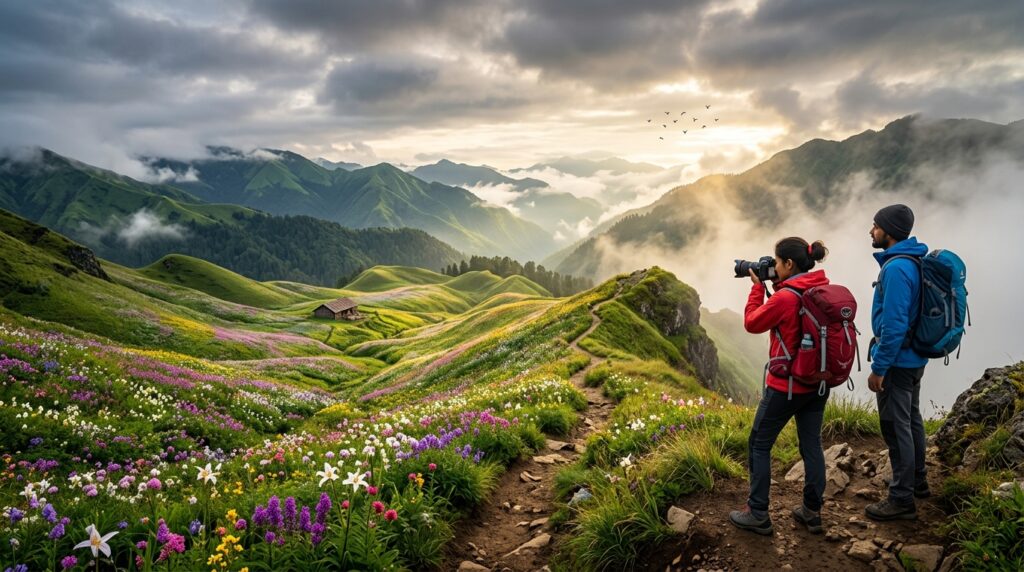
Most travelers pick one or the other. A week in Assam for the wildlife, or a week in Meghalaya for the scenery. What they don’t realize is that these two states sit right next to each other, share a border, and offer such a complete contrast of landscape, culture, and experience that doing them back to back turns a good trip into an exceptional one.
Assam is flat, wet, and wild the Brahmaputra floodplains, tall elephant grass, and one of the world’s greatest concentrations of large mammals. Meghalaya climbs into the hills immediately to the south forested ridges, the cleanest rivers in India, living root bridges, and a Khasi hill culture that has almost nothing in common with anything else in the subcontinent. The transition between the two, which happens over a single afternoon’s drive, is one of the most dramatic landscape shifts you can experience without crossing an international border.
This guide explains what makes each state worth visiting, why the combination works so well, and what you should realistically expect from a trip that covers both.
Assam: Where the Wildlife Numbers Are Simply Extraordinary
Before anything else, a number: Kaziranga National Park alone holds more than 2,600 Indian one-horned rhinoceroses. That is more than two-thirds of the entire global population of the species, concentrated in one park of roughly 430 square kilometres.
This is the result of serious, sustained conservation effort over more than a century. When the park was first notified in 1905, the rhino population had been hunted to near-extinction. The recovery since then is one of conservation’s genuine success stories, and visiting Kaziranga today watching a rhino walk through tall grass at sunrise, completely unbothered by your presence is a direct encounter with what that effort has produced.
What Kaziranga Actually Looks Like
The park sits on the southern bank of the Brahmaputra River in central Assam, occupying a landscape of tall elephant grass, wetlands, and Sal forest. It floods every monsoon, which is part of why it’s so productive as wildlife habitat the annual flooding cycles deposit nutrients, control vegetation, and create the diversity of ecosystems that support so many species.
In the dry season (October to April), the grass is shorter, the animals are more visible, and the jeep tracks through the park are accessible. The central Kohora range has the highest rhino density and is where most safaris begin. The western Bagori range is excellent for elephants. The eastern Agoratoli range sees fewer visitors and offers a quieter experience.
Beyond the Rhino
Kaziranga is not just a rhino park, though it’s easy to think of it that way. The park holds:
- Asian elephants in large herds 1,000+ individuals recorded in the park
- Wild water buffalo among the largest bovines in the world, impressive at close range
- Swamp deer (barasingha) a species that thrives in the park’s wetland habitat
- Royal Bengal tiger Kaziranga has one of India’s highest tiger densities, though the tall grass makes sightings harder than at Ranthambore or Bandhavgarh
- Over 480 bird species making it a serious destination for birdwatching alongside the mammal watching
The elephant safari experience sitting on an elephant’s back and moving slowly through the tall grass at dawn is unique to Kaziranga and worth doing at least once. The height gives you a perspective on the grassland that a jeep safari can’t replicate.
Assam Beyond Kaziranga
Guwahati, Assam’s largest city, is the gateway most travelers pass through but few spend time in. It’s worth at least an evening. The Kamakhya Temple on Nilachal Hill is one of India’s most significant Shakti temples, drawing pilgrims year-round and offering a view over the Brahmaputra that is particularly good at sunset. The riverfront area along the Brahmaputra gives a sense of how central the river is to Assamese life and geography.
Assam’s food culture is distinctive and worth engaging with seriously. Assamese cuisine uses mustard oil, fermented bamboo shoot, and river fish in ways that differ from both North Indian and Bengali cooking. The state is also India’s largest tea producer almost every hill in upper Assam is a tea garden, and visiting one gives you an understanding of where your tea actually comes from.
Meghalaya: What Happens When the World’s Wettest Region Meets Highland Culture
Meghalaya means “abode of clouds” in Sanskrit. The name is accurate. The state occupies the Khasi, Jaintia, and Garo hills south of the Brahmaputra valley, and it receives more rainfall than almost anywhere on earth. Mawsynram and Cherrapunji, both in Meghalaya, compete annually for the title of the world’s wettest place.
All that rainfall has consequences. The rivers are extraordinary. The forests are extraordinary. And the communities who have lived in these hills for millennia have developed a relationship with their environment and particularly with water and forest that is unlike anything else in India.
The Rivers: Why Meghalaya’s Water Is Different
The Umngot River, which flows near the villages of Shnongpdeng and Dawki close to the Bangladesh border, is frequently described as the clearest river in India. This is not hyperbole. The riverbed is visible at depths of 5–6 metres. Boats appear to float in mid-air above the transparent water. The clarity is the result of the Umngot’s catchment area being almost entirely forested no agriculture, no significant human settlement, no industrial activity along its course.
Swimming in the Umngot during the dry season is an experience that people from cities find genuinely startling. The water is cold, clear, and clean in a way that most urban Indians haven’t encountered since childhood.
The river isn’t the only water feature that defines Meghalaya. The state has an extraordinary concentration of waterfalls Nohkalikai Falls near Cherrapunji drops 340 metres, making it India’s tallest plunge waterfall. The Seven Sisters Falls (Nohsngithiang) presents seven distinct streams that fall simultaneously from a cliff face. During monsoon, these falls are at peak flow. In the dry season, they’re more accessible and still impressive.
Living Root Bridges: Engineering Without Tools
The Khasi communities of Meghalaya have, over several generations, trained the aerial roots of rubber fig trees (Ficus elastica) to grow across streams and rivers, creating living bridges that strengthen over time rather than weakening. The most famous the double-decker living root bridge at Nongriat village near Cherrapunji has two bridge levels, takes about 3,000 steps to reach, and is strong enough to hold 50 people simultaneously.
These bridges take 15 to 30 years to reach functional strength. They are maintained by the communities that built them. The oldest are over 500 years old. There is nothing quite like them anywhere else in the world a functional infrastructure built entirely from living biological material, requiring no tools, no manufactured components, and no maintenance in the conventional sense.
Shillong: A Hill Station That Doesn’t Fit the Type
Shillong sits at 1,500 metres and has been a hill station since the British made it the capital of Assam province in 1874. But it doesn’t feel like Shimla or Mussoorie. The Khasi culture gives it a different character a strong musical tradition (Shillong produces a disproportionate number of India’s best rock musicians), Presbyterian church architecture, bustling local markets, and a food culture centered on smoked meats, jadoh (rice cooked with pork), and local rice beer.
The Don Bosco Centre for Indigenous Cultures in Shillong is one of the best museums in Northeast India seven floors covering the material culture, history, and traditions of the indigenous communities of the entire Northeast region. It’s genuinely worth three to four hours.
Ward’s Lake, the colonial-era botanical gardens, and Bishop and Beadon Falls in the city are pleasant without being essential. The more interesting use of time in Shillong is walking the local markets Police Bazar and Lewduh (Bara Bazar) and eating at the small local restaurants that serve authentic Khasi food.
Why These Two States Work So Well Together
The combination of Assam and Meghalaya works because the contrast is so complete. Here’s what you move between:
- Landscape: Flat river plains and tall grassland → steep forested hills and river gorges
- Wildlife: Megafauna (rhino, elephant, buffalo) in open grassland → endemic flora, cave ecosystems, and the human-natural infrastructure of living root bridges
- Culture: Assamese plains culture (Hindu, tea-growing, Brahmaputra-centered) → Khasi matrilineal hill culture (predominantly Christian, forest-centered, with a distinct language, music, and social structure)
- Pace: Kaziranga operates on safari timings early mornings, structured game drives → Meghalaya rewards slower exploration, long walks to root bridges, afternoons on a clear river
The transition itself the drive from Guwahati south into the Khasi Hills toward Shillong is one of the most visually dramatic road sections in Northeast India. You climb from the Brahmaputra plains at near-sea-level into forested hills at 1,500 metres in about two hours, and the air, the light, and the temperature all change as you climb.
Practical Information
- Best time for both states: October to March is the ideal window. Kaziranga is open and dry-season safaris give the best wildlife visibility. Meghalaya is clear and cool, and the Umngot River is at peak transparency. April works well too slightly warmer, greener, and the pre-monsoon light in Meghalaya is excellent.
- What to avoid: June to September. Kaziranga closes for monsoon as the park floods. Meghalaya is extraordinarily wet impressive but the river activities aren’t possible and road conditions in the hills can be difficult.
- Getting there: Fly or take the train to Guwahati. All roads north to Kaziranga (220 km, about 4–5 hours) and south to Shillong (100 km, about 3 hours) start from Guwahati. Private transport throughout is strongly recommended public buses exist but the timing of safari slots makes them impractical.
- Permits: No special permits required for Indian nationals on this circuit. Foreign nationals should check current entry requirements for Meghalaya’s border areas near Dawki/Shnongpdeng.
- Safari booking: Kaziranga safari permits for the Kohora (central) range should be booked in advance during peak season (December–February). Slots are limited and fill up. Our package handles all safari bookings.
Frequently Asked Questions
How many days do I need for both Assam and Meghalaya?
A minimum of 7 nights gives you 2 nights at Kaziranga (3 safaris), 1 night in Guwahati, and 3–4 nights in Meghalaya covering Shillong and the southern river areas. Rushing it below 7 nights means cutting somewhere meaningful.
Is it possible to see a tiger at Kaziranga?
Tiger sightings at Kaziranga are possible the park has one of India’s highest tiger densities but not common. The tall elephant grass that the tigers use for cover makes sightings harder than at drier parks like Ranthambore. Come with rhinos, elephants, and buffalo as your primary targets and a tiger sighting as a bonus.
Which part of Meghalaya is worth the most time?
For most travelers, the Shillong base with day trips to Cherrapunji, the living root bridges, and the Umngot River area gives the most complete experience. The Garo Hills in western Meghalaya are worth a separate dedicated trip.
Is this trip suitable for families with children?
Yes. Kaziranga safaris work well for children aged 5 and above the wildlife sightings are reliable enough to keep kids engaged. The root bridge trek at Nongriat requires good walking ability (3,000 steps each way) and is better suited to children 8 and above. The river at Shnongpdeng is safe for swimming in dry season.
What should I pack for this trip?
Binoculars for Kaziranga (essential), waterproof footwear for Meghalaya’s trails, a warm fleece for Shillong evenings (cool year-round at 1,500m), and a rain layer even in dry season Meghalaya earns its name.
Two States, One Complete Trip
The travelers who get the most from Northeast India are the ones who resist the urge to pick one state and “do it properly.” Assam and Meghalaya together, in a week to ten days, give you wildlife, landscape, culture, and genuine natural phenomena that don’t exist anywhere else in India and the contrast between them makes each state more vivid than it would be on its own.
Our Kaziranga, Guwahati, Shillong, and Pynursla package covers this entire circuit with private transport, accommodation, Kaziranga safari, and local guide throughout.
View the full Kaziranga + Meghalaya Package
Chat with us on WhatsApp tell us your group size and travel dates and we’ll help you plan the right version of this trip.